
Faiz Yar Khan
July 15, 2026
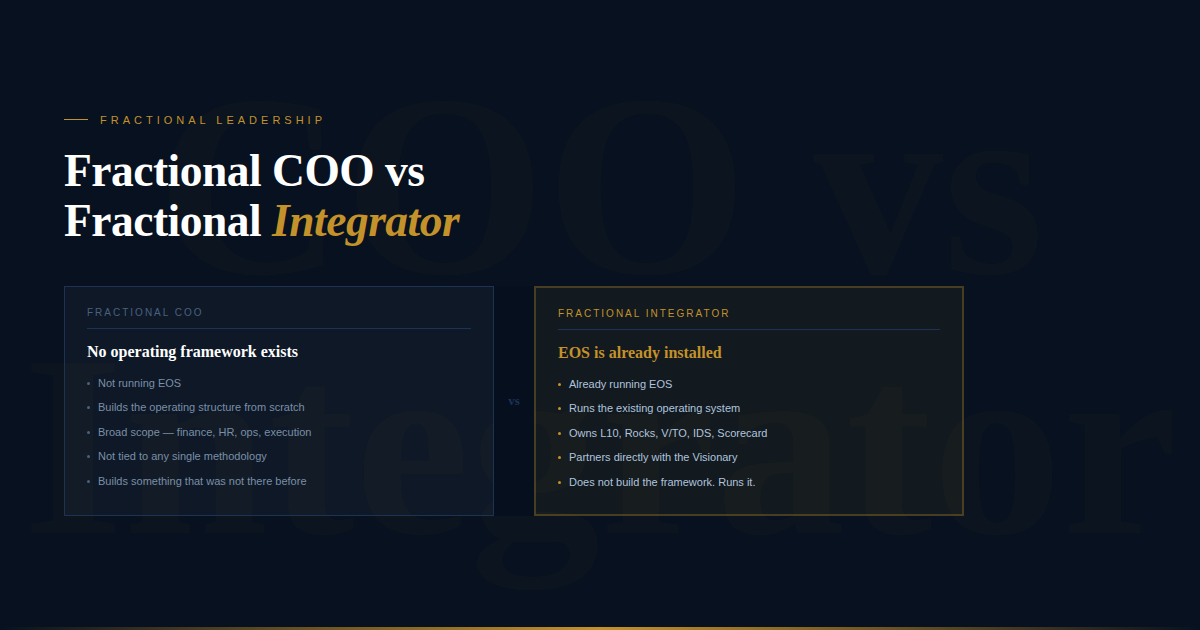
The simplest way I can put it is this. If your company is running EOS, you likely need a Fractional Integrator. If it is not, you likely need a Fractional COO.
Everything else in this article is the detail behind that distinction.
A Fractional COO comes in when the operating framework does not exist or does not work. The company has grown past the point where the founder can carry everything personally but nobody has built the structure that would let the team carry it instead.
The COO is not tied to any single methodology. The job is to look at the business as it actually is, how decisions get made, where accountability breaks down, what the leadership team owns versus what still routes back to the founder, and build the operating structure that fits that specific company. That means defining direction clearly enough that every leader on the team can give the same answer when asked where the company is going. Assigning accountability with enough specificity that ownership is real. Designing and running the operating rhythm that keeps priorities protected and issues resolved without the founder driving every conversation. Something is being built that was not there before.
The scope is broad. Finance, HR, operations, cross-functional execution. The COO draws from whatever frameworks and tools serve the company’s actual situation rather than fitting the business into a predetermined system.
The Integrator is a specifically defined role within EOS and it only applies to companies already running on the Entrepreneurial Operating System.
Within EOS, Gino Wickman and Mark Winters describe the Integrator in Rocket Fuel as the organizational glue, the person who holds the organization’s people, processes, systems, priorities, and strategies together. The Integrator works in direct partnership with the Visionary as the person responsible for turning the Visionary’s direction into execution. The Visionary focuses on where the company is going. The Integrator makes sure the company gets there.
In practice that means owning and running the L10, driving Rock completion, holding same-page meetings with the Visionary every week, and making sure the IDS process actually resolves issues rather than just discussing them. But the Integrator’s job is not purely operational. It is relational. A strong Integrator protects the Visionary from getting pulled back into daily operations so they can stay focused on the role only they can play.
The Integrator does not build the operating system. They run it.
Some EOS companies have drifted far enough from the framework that it needs to be substantially rebuilt before anyone can run it properly. You can usually tell within the first meeting. Someone describes their Rock and what they are actually describing is a task list. The V/TO exists as a document but nobody on the leadership team can tell you what the three-year picture says without pulling it up. The Scorecard has numbers but nobody is sure who owns them or what happens when one goes red. In those situations the work starts closer to COO territory before it can move into Integrator work. The system has to be rebuilt before it can be run. That happens more than people expect.
If the first conversation when I walk in is about what the business needs to build operationally, it is a COO engagement. If the first conversation is about why the EOS system that is already installed is not producing the traction it should, it is an Integrator engagement.
One way I have heard it put simply: if you are committed to EOS, you need an Integrator. If you are not running a specific methodology and need someone to build the operating structure from the ground up, you need a Fractional COO.
The reason I walk founders through this before anything else is that bringing in the wrong support creates its own problems. An Integrator trying to run a system that was never properly built will hit a wall fast. A COO rebuilding something that just needed someone to own the execution seat wastes time the business did not need to spend.
Which situation you are actually in is the question worth answering first.
© 2026 Yar Khan Consulting. All rights reserved. | Chicago, IL | Privacy Policy
EOS®, Entrepreneurial Operating System®, EOS Implementer®, Traction®, and Rocket Fuel® are registered trademarks of EOS Worldwide, LLC. Integrator™, Visionary™, Rocks™, Scorecard™, Level 10 Meeting™, V/TO™, Accountability Chart™, and IDS™ are trademarks of EOS Worldwide, LLC. SAFe® is a registered trademark of Scaled Agile, Inc.