
Faiz Yar Khan
July 15, 2026
I have had versions of the same conversation more times than I can count.
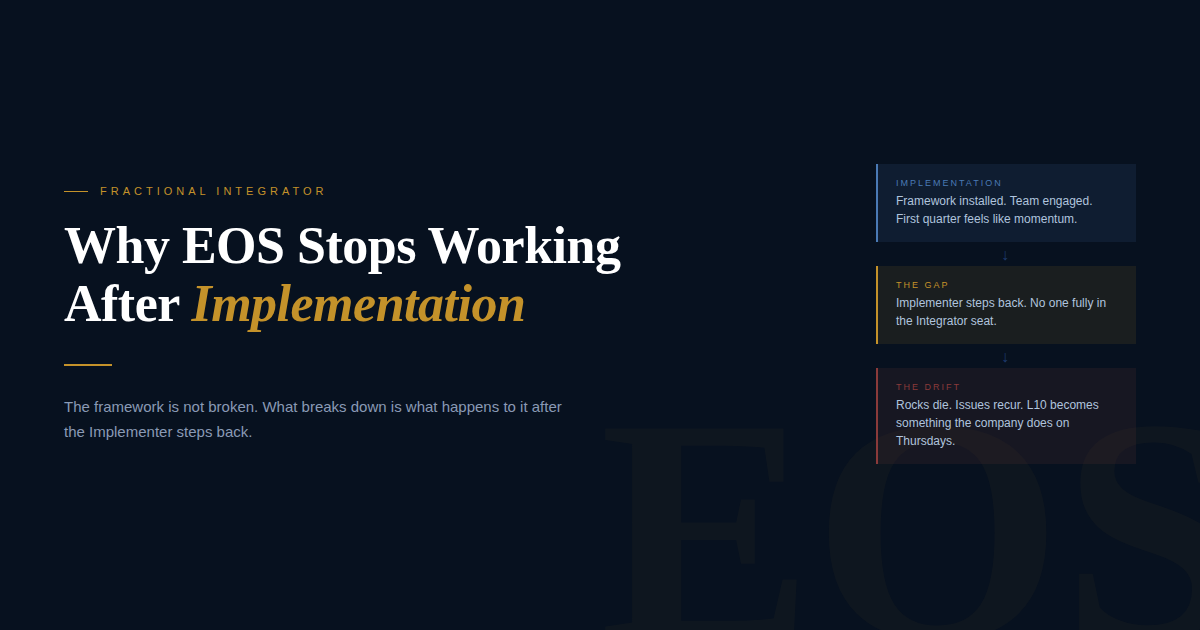
A Visionary calls me six to twelve months after their EOS implementation ended. The implementation went well. The team was engaged and the first quarter felt like real momentum.
Then something started slipping. Rocks that were set with conviction died by week eight. The L10 became a meeting people tolerated rather than a tool they trusted. The Issues List grew longer instead of shorter. And the Visionary, who was supposed to be focused on where the company was going, found themselves pulled back into operational decisions they thought the system was supposed to handle.
They usually call it an EOS problem. In almost every case it is not.
EOS works when it is run properly. What breaks down is almost never the framework. What breaks down is what happens to it after the Implementer steps back.
What I actually see in those situations is a team that learned the tools but never made them their own. They know what an L10 is. They know what a Rock is supposed to look like. They can explain IDS. But EOS never changed how they think between meetings. It stayed as a weekly meeting structure rather than changing how the team makes decisions and holds each other accountable on a Tuesday afternoon when nobody is watching.
People leave the L10 with to-dos and good intentions and then the week takes over. By Thursday the energy behind last week’s commitments has gone somewhere and the meeting starts again from roughly where it ended. The issues that needed to get solved did not. The Rocks that needed to move did not. And the team sits back down and does it all again.
It almost always comes back to the same thing. Nobody is fully in the Integrator seat holding the system together between meetings, not just during them.
The Implementer’s job is to install the framework and teach the team how to use it. But installation is not the same as operation. The Implementer cannot be in the room every week making sure the L10 actually runs the way it is supposed to. They cannot own the IDS process, drive Rock completion between sessions, hold a same-page conversation with the Visionary every week, or catch the moment when the Issues List stops being a place where things get resolved and starts being a place where things go to get acknowledged and come back next week.
That is the Integrator’s job. Without someone fully in that seat, EOS stays a set of tools the company uses rather than a system the company actually runs on.
The Visionary usually ends up carrying both roles by default. In the early months that works. Their presence keeps things moving. But the Visionary’s job is to be focused on where the company is going, not tracking whether last week’s to-dos got done before Thursday’s meeting. That split wears on both over time.
The system does not fall apart suddenly when this happens. It drifts. The meetings keep happening. The Rocks keep getting set. But EOS has stopped being how the company operates and started being something the company does on Thursdays.
The fix is rarely a full reimplementation. The foundation is usually still solid. What is missing is someone whose job is to make EOS part of how the business actually runs every day, not just the one hour a week when everyone is in the same room.
© 2026 Yar Khan Consulting. All rights reserved. | Chicago, IL | Privacy Policy
EOS®, Entrepreneurial Operating System®, EOS Implementer®, Traction®, and Rocket Fuel® are registered trademarks of EOS Worldwide, LLC. Integrator™, Visionary™, Rocks™, Scorecard™, Level 10 Meeting™, V/TO™, Accountability Chart™, and IDS™ are trademarks of EOS Worldwide, LLC. SAFe® is a registered trademark of Scaled Agile, Inc.